The Department of History and Philosophy is home to a dynamic community of scholars
whose research advances knowledge across diverse historical periods, philosophical
traditions, and geographic regions. This page showcases faculty research interests
and areas of expertise, highlights the regions they study, and features recent publications
that reflect the breadth and impact of their scholarship.
Research by Topics
HISTORY
SOCIAL & CULTURAL
Social history is the study of ordinary people and everyday life (e.g., classes, families, communities,
work, and social relations) rather than elites and high politics.
Cultural history is the study of the beliefs, values, symbols, rituals, and shared mental worlds of
a society, or how people made meaning and understood their experience.
Subject
Definition
Faculty
DIASPORA STUDIES
Diaspora studies examines populations that have been dispersed from an original homeland and the relationships they maintain—real or imagined—with that homeland and with the societies they settle in. The recurring concerns are identity, displacement, belonging, collective memory, and the transnational ties that link scattered communities across borders and generations.
Yoshina Hurgobin
Citizenship, Migration and Disease in Modern South Asia and the Indian Ocean
Bryan McGovern
19th Century Irish and Irish American History
Seneca Vaught
Race, Culture, and Policy in Black Studies
WOMEN'S HISTORY
Women's history is the study of women's experiences, roles, and contributions in the past – recovering lives, work, activism, and perspectives that traditional history, focused on male elites, largely left out.
Lauren Thompson
Reproductive Health, Women's Rights, and the Law
MUSIC & MEDIA
Music history is the study of music of the past—composers, works, genres, styles, and performance practices, along with the changing place of music in societies over time.
Media history is the study of the means of communication and their development over time –the press and print, photography, film, radio, television, and digital and networked media—and the social, cultural, and political effects of each.
Amy Dunagin
17th/18th Century Great Britian
Jonathan Gentry
Modern German Music and Culture
FOLK TRADITION
Folk tradition history is the study of the traditional customs, beliefs, stories, songs, crafts, and rituals of ordinary people—the culture passed down largely by word of mouth and informal practice rather than through official institutions—and how these traditions formed, spread, and changed over time.
Hakki Gurkas
Islamic Folk and Festival Tradition in the Middle East and Central Asia
URBAN STUDIES
Urban history is the study of cities and towns over time—how they emerged, grew, were built and governed, and how people lived in them. It examines both the physical city (its architecture, infrastructure, planning, and spatial layout) and the social city (the communities, classes, work, and daily life that urban environments shaped and were shaped by).
LeeAnn Lands
20th Century US Urban and Suburban History
POLITICAL
Political history is the study of power, government, and the state – rulers, institutions, political movements, elections, and the exercise and contest of authority.
The history of nationalism is the study of how nations and nationalism came into being,
how they developed, and how they reshaped the modern world. It examines national identity,
nation-building, the rise of nation-states, and nationalist movements.
FACULTY EXPERTS
Jonathan Gentry
Modern German Music and Culture
Bryan McGovern
19th Century Irish and Irish American History
Legal history is the study of law and legal systems over time—how laws, doctrines, courts, legal institutions, and the legal profession developed and changed, and how law has interacted with the surrounding society, politics, and economy.
Public policy history is the study of how governments have addressed social and economic problems over time—how particular policies were formulated, implemented, contested, and revised, and what effects they had.
FACULTY EXPERTS
Albert Churella
Transportation History and Policy
Lauren Thompson
Reproductive Health, Women's Rights, and the Law
Seneca Vaught
Race, Culture, and Policy in Black Studies
ECONOMIC
Economic history is the study of how economies and economic activity have developed over time: production,
trade, consumption, labor, money, markets, growth, and the material conditions of
life across societies.
Business history is the study of business enterprises, entrepreneurs, management, and industries—how firms were founded, financed, organized, and managed, how industries developed, and how businesses both shaped and were shaped by their economic and social environments.
FACULTY EXPERTS
Albert Churella
Transportation History and Policy
Randy Patton
Business History, Georgia History
Labor history is the study of working people, work, and the labor movement over time—workers and their conditions, the experience of working life, trade unions, strikes, labor politics, and the relations between workers, employers, and the state.
FACULTY EXPERTS
Alice Pate
Russian Labor and Intellectual History
Randy Patton
Business History, Georgia History
Yoshina Hurgobin
Citizenship, Migration and Disease in Modern South Asia and the Indian Ocean
DIPLOMATIC
Diplomatic history is the study of relations between states – treaties, negotiations, alliances, and the conduct of foreign policy.
The history of foreign relations is the study of how states and other actors have interacted across borders over time—diplomacy, war, alliances, trade, and the making and conduct of foreign policy.
FACULTY EXPERTS
Paul Dover
Medieval Europe, Diplomacy and Internation Politics in Renaissance, History of Information
Brian Etheridge
American Foreign Relations
Silke Zoller
Terrorism and Political Violence
The history of terrorism is the study of the use of violence for political ends—chiefly by non-state actors, though states practice terror too—and how it has developed as a tactic, a concept, and a phenomenon over time, along with the responses it provokes.
FACULTY EXPERTS
Silke Zoller
Terrorism and Political Violence
International conflict analysis and management concerns how international conflicts
arise, escalate, and can be contained, resolved, or managed, and historically it examines
the development of the tools and institutions built for that purpose: diplomacy and
mediation, arbitration and international law, arms control, and peacekeeping.
FACULTY EXPERTS
Seneca Vaught
Race, Culture, and Policy in Black Studies
Silke Zoller
Terrorism and Political Violence
INTELLECTUAL
Intellectual history is the study of ideas and the thinkers who produce them, traced through time and understood
in their contexts. It asks how people thought, what concepts they used, and why certain
ideas emerged, spread, changed, or faded when they did.
FACULTY EXPERTS
Masako Racel
Intellectual History of Japan
Alice Pate
Russian Labor and Intellectual History
Katya Vladimirov
Russian and Soviet Intellectual History
History of memory is the study of how the past is remembered, commemorated, and represented—how societies and groups construct, transmit, and contest collective memory, rather than what "actually" happened.
FACULTY EXPERTS
Marianne Holdzkom
Colonial/Revolutionary US History, History of Memory
David Parker
American South & Georgia History
The history of information is the study of how information has been created, recorded, stored, organized, transmitted, and used across human history—and of how the systems and technologies for handling information have shaped societies.
FACULTY EXPERTS
Paul Dover
Medieval Europe, Diplomacy and Internation Politics in Renaissance, History of Information
Jonathan Gentry
Modern German Music and Culture
SCIENCE & MEDICINE
The history of science is the study of how scientific knowledge, practice, and institutions developed over time—how people have understood the natural world, how scientific ideas and methods emerged and changed, and how science relates to its social, cultural, and intellectual surroundings.
The history of medicine is the study of medicine, health, disease, healing, and the body over time—medical theory and practice, the medical profession, hospitals and other institutions, public health, and the experience of being ill.
FACULTY EXPERTS
Lauren Thompson
Reproductive Health, Women's Rights, and the Law
AGRICULTURE & ENVIRONMENT
Agricultural history is the study of farming over time—crops and livestock, land use, farming techniques and technology, agricultural systems, productivity, and the social and economic organization of working the land.
Environmental history is the study of the changing relationship between human societies and the natural world—how people have shaped, used, and imagined their physical environment, and how that environment has in turn shaped them.
FACULTY EXPERTS
Tom Okie
American Agricultural and Environmental History, Georgia History
Jiayan Zhang
Chinese Agrarian and Environmental History
PUBLIC HISTORY
Public history is the practice of history produced for and, ideally, with general audiences, in
museums, archives, historic sites, national parks, government agencies, documentary
media, and communities.
FACULTY EXPERTS
Catherine Lewis
Public History, Museum Studies, WWII and the Holocaust, Women's History
EDUCATION
The history of education is the study of how education has developed over time—schooling and teaching, learning, educational institutions, curricula, and educational ideas—and how all of this relates to the surrounding society, politics, economy, and culture.
FACULTY EXPERTS
Caroline Conner
Social Studies Education, American Education
Nefertari Yancie
Social Studies Education
PHILOSOPHY
FEMINIST & EPISTEMOLOGY
Feminist philosophy uses the tools of philosophy to examine gender, and especially to understand and
challenge the ways women have been subordinated and the ways philosophy itself has
been shaped by male assumptions.
Epistemology is the theory of knowledge. It asks what knowledge is, what we can know, and what makes a belief justified or rational.
FACULTY EXPERTS
Amy Donahue
Research by Region
UNITED STATES
Albert Churella
Transportation History and Policy
Caroline Conner
Social Studies Education, American Education History
Kris DuRocher
Identity and Culture
Brian Etheridge
American Foreign Relations
Marianne Holdzkom
Colonial/Revolutionary US History, History of Memory
LeeAnn Lands
20th Century US Urban and Suburban History
Catherine Lewis
Public History, Museum Studies, WWII and the Holocaust, Women's History
Bryan McGovern
19th Century Irish and Irish American History
Tom Okie
American Agricultural and Environmental History, Georgia History
David Parker
American South & Georgia History
Randy Patton
Business History & Georgia History
Lauren Thompson
Reproductive Health and Women's Rights
Seneca Vaught
Race, Culture, and Policy in Black Studies
Nefertari Yancie
Social Studies Education
Silke Zoller
Terrorism and Political Violence
EUROPE
Paul Dover
Medieval Europe, Diplomacy and Internation Politics in Renaissance, History of Information
Amy Dunagin
17th/18th Century Great Britian
Jonathan Gentry
Modern German Music and Culture
Brian Swain
Greek and Roman Antiquity
Alice Pate
Russian Labor and Intellectual History
Katya Vladimirov
Russian and Soviet Intellectual History
ASIA
Amy Donahue
Asian, Feminist, and Epistemology - Philosophy
Hakki Gurkas
Islamic Folk and Festival Tradition in the Middle East and Central Asia
Yoshina Hurgobin
Citizenship, Migration and Disease in Modern South Asia and the Indian Ocean
Masako Racel
Intellectual History of Japan
Jiayan Zhang
Chinese Agrarian and Environmental History
AFRICA
Ryan Ronnenberg
African History
Seneca Vaught
Race, Culture, and Policy in Black Studies
Recent Publication Highlights
BOOKS & EDITED VOLUMES
2025
MacKenzie, Matthew with Amy Donahue & Anand Vaidya, eds. Thinking without Borders: Essays in Honor of Arindam Chakrabarti. Bloomsbury Academic, 2025.
Zhang, Jiayan. Dikes and Society in Rural China: The Jianghan Plain, 1788–2010s. Leiden: Brill, 2025.
2024
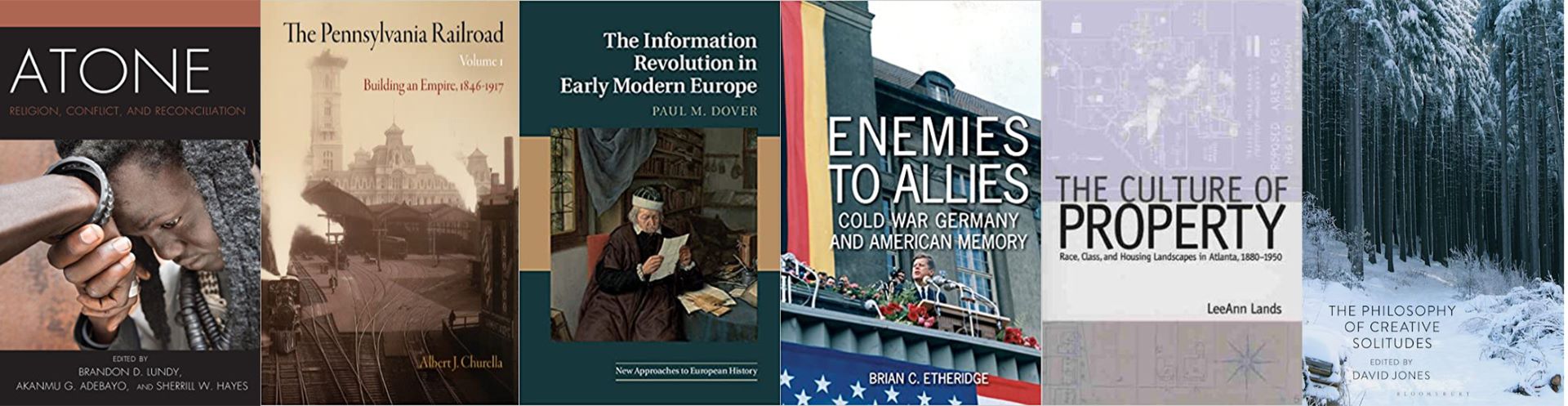
Churella, Albert J. The Pennsylvania Railroad: The Long Decline, 1933–1968. Bloomington: Indiana University Press, 2024.
2023
Churella, Albert J. The Pennsylvania Railroad: The Age of Limits, 1917–1933. Bloomington: Indiana University Press, 2023.
Dover, Paul M., ed. Engaging with the Past and Present: The Relationship between Past and Present across
the Disciplines. Routledge, 2023.
Holdzkom, Marianne. Remembering John Adams: The Second President in History, Memory and Popular Culture. Jefferson, NC: McFarland, 2023.
Lands, LeeAnn B. Poor Atlanta: Poverty, Race, and the Limits of Sunbelt Development. Athens: University of Georgia Press, 2023.
2022
Jabbaar-Gyambrah, Tara, and Seneca Vaught. The Roadmap to Investing in Yourself: The Real Costs of a College Education. Rowman & Littlefield, 2022.
Marcus, Bernie, with Catherine M. Lewis. Kick Up Some Dust: Lessons on Thinking Big, Giving Back, and Doing It Yourself. New York: William Morrow, 2022.
Walker, Devin L., Linda M. Lyons, and Seneca Vaught, eds. Historically Underrepresented Faculty and Students in Education Abroad : Wandering Where We Belong. Palgrave Macmillan, 2022.
2021
Dover, Paul M. The Information Revolution in Early Modern Europe. Cambridge: Cambridge University Press, 2021.
Zoller, Silke. To Deter and Punish: Global Collaboration Against Terrorism in the 1970s. New York: Columbia University Press, 2021.
BOOK CHAPTERS
2025
Donahue, Amy. "To Counter Propaganda and Disinformation, Think Beyond Modernity".
In Inquiry: Philosophical Perspectives, edited by Aaron B. Creller and Jonathan Matheson. Routledge, 2025.
Zoller, Silke. "Shaping a New Threat: How the CIA Defined 'International Terrorism'
in the 1970s." In Secrets on Display: Stories and Spycraft from the International Spy Museum, edited by Mark Stout and Sarah-Jane Corke. University Press of Kansas, 2025.
2024
Vladimirov, Katya. "The Bureaucracy of Russian Poland, 1870 – 1905: A Profile of the Elite" In Climbing up the Social Ladder?: Social Mobility of Elites in East-Central Europe in
the Long 19th Century edited by Vlad Popovici, Alice Velková and Martin Klečacký, 125-148. Berlin, Boston: De Gruyter Oldenbourg, 2024.
2023
Yancie, Nefertari, and R. M. Bidwell. "The Notorious R.B.G.: Ruth Bader Ginsburg and
Her Fight for Equality." In Thematic Teaching of Women's Rights Issues with Social Studies Trade Books, edited by Natalie Keefer and Jeremiah Clabough. Information Age Publishing, 2023.
Zoller, Silke. "Terrorist Extradition Through the Ages." In Terrorism Through the Ages, edited by Graham Wrightson. Leiden:Brill, 2023.
2022
Racel, Masako N. “Kokumin Dōtoku for Women: Shimoda Utako in the Taishō Era.” In Handbook of Confucianism in Modern Japan, edited by Shaun O’Dwyer, 77–92. Handbooks on Japanese Studies. Amsterdam University Press, 2022.
JOURNAL ARTICLES
2025
Baker, Andrew C., and William Thomas Okie. “Writing in Place: An Introduction.” Agricultural History 99, no. 4 (2025): 509–35.
Conner, Caroline J., Chara Haeussler Bohan, and Joanna Badger. "Preparing Teachers
in Holocaust Education During Polarizing Times." Journal of Education (2025).
Parker, David B. "Eugene Talmadge’s Library Book Purge of 1941". Georgia Library Quarterly 62, no. 4 (2025).
Pate, Alice K. “Media’s Impact on US-Russian Relations: US Newspapers Respond to the 1917 Revolutions.” Revolutionary Russia 38, no. 2 (2025): 164–86.
Yancie, Nefertari. "Giants of Civil Rights: Fostering Historical Empathy Skills by
Examining the Debate Between Washington and Du Bois." The Social Studies (2025): 1–15.
Yancie, Nefertari. "History's Unsung Hero: Examining Oscar Dunn and African American
History through a Graphical Novel." The Councilor: A National Journal of the Social Studies 88, no. 1 (2025).
2024
Okie, William Thomas. "Teaching for Surprise: Oral History, Document Interpretation,
and Historical Thinking in an International Context." The History Teacher 58, no. 1 (2024): 77–106.
Paracka, Daniel J., and Seneca D. Vaught. “From God to Orphan: The Deep Humanity and Deep Ecology of Limba Palm Wine Practice.” Journal of Africana Religions 12, no. 1 (2024): 104–40.
Parker, David B. "From Oglethorpe to the Lost Cause: The Early History of Georgia Day". Journal of the Georgia Association of Historians 40, (2024): 1-25.
Thompson, Lauren MacIvor. “Abortion, Contraception, and the Comstock Law’s Original Medical Exemption, 1873–1936.” The Journal of the Gilded Age and Progressive Era 23, no. 4 (2024): 444–51.
2023
Conner, Caroline, and Amanda Miskewicz. "Attacking Antisemitism: Investigating How
Museum-Led Professional Development Affects Preservice Teachers' Preparedness to Teach
the Holocaust." Curriculum and Teaching Dialogue 25, nos. 1–2 (2023): 115–32.
Dunagin, Amy. "Liberty or Death: Patrick Henry, Theatrical Song, and Transatlantic
Patriot Politics." Early American Studies 21, no. 3 (2023): 491–505.
2022
Donahue, Amy. "Pramāṇavāda and the Crisis of Skepticism in the Modern Public Sphere." Journal of World Philosophies 7 (2022): 1–14.
Etheridge, Brian, Christopher Duncan, and M. Jeremy. "Serious Analog Game Development
Across Disciplines." Analog Game Studies 9, no. 2 (2022).
Gentry, Jonathan. "Unveiling Musical Production: Strauss, Mahler and Commodity Fetishism
in the Late Nineteenth Century." Nineteenth-Century Music Review 19, no. 3 (2022): 459–80.
McGovern, Bryan P. "Richard O'Gorman and Young Ireland on Race, Class, and Culture
in Nineteenth-Century Irish America." New Hibernia Review 26, no. 2 (2022): 112–31.
Thompson, Lauren MacIvor, and Kelly O’Donnell. “Contemporary Comstockery: Legal Restrictions on Medication Abortion.” Journal of General Internal Medicine 37 (2022): 2564–2567.
2021
Gurkas, Hakki. “Common Trends in Saint Veneration in Turkish Festive Culture in the Twentieth Century.” Journal of the Ottoman and Turkish Studies Association 8, no. 2 (2021): 119.
Gürkaş, Hakkı. “Innovation in Religious Tradition: From the Blessed Birth to the Mevlid-i Nebi, 1989-2019.” Journal of the Middle East & Africa 12, no. 4 (2021): 425–44.
Thompson, Lauren MacIvor. “‘The Offspring of Drunkards’: Gender, Welfare, and the Eugenic Politics of Birth Control and Alcohol Reform in the United States.” Journal of Law, Medicine & Ethics 49, no. 3 (2021): 357–64.
Vladimirov, Katya. "We, the People: Profiling Soviet Party Elites, 1900s–1990s." Historická Demografie 45, no. 2 (2021): 177–202.