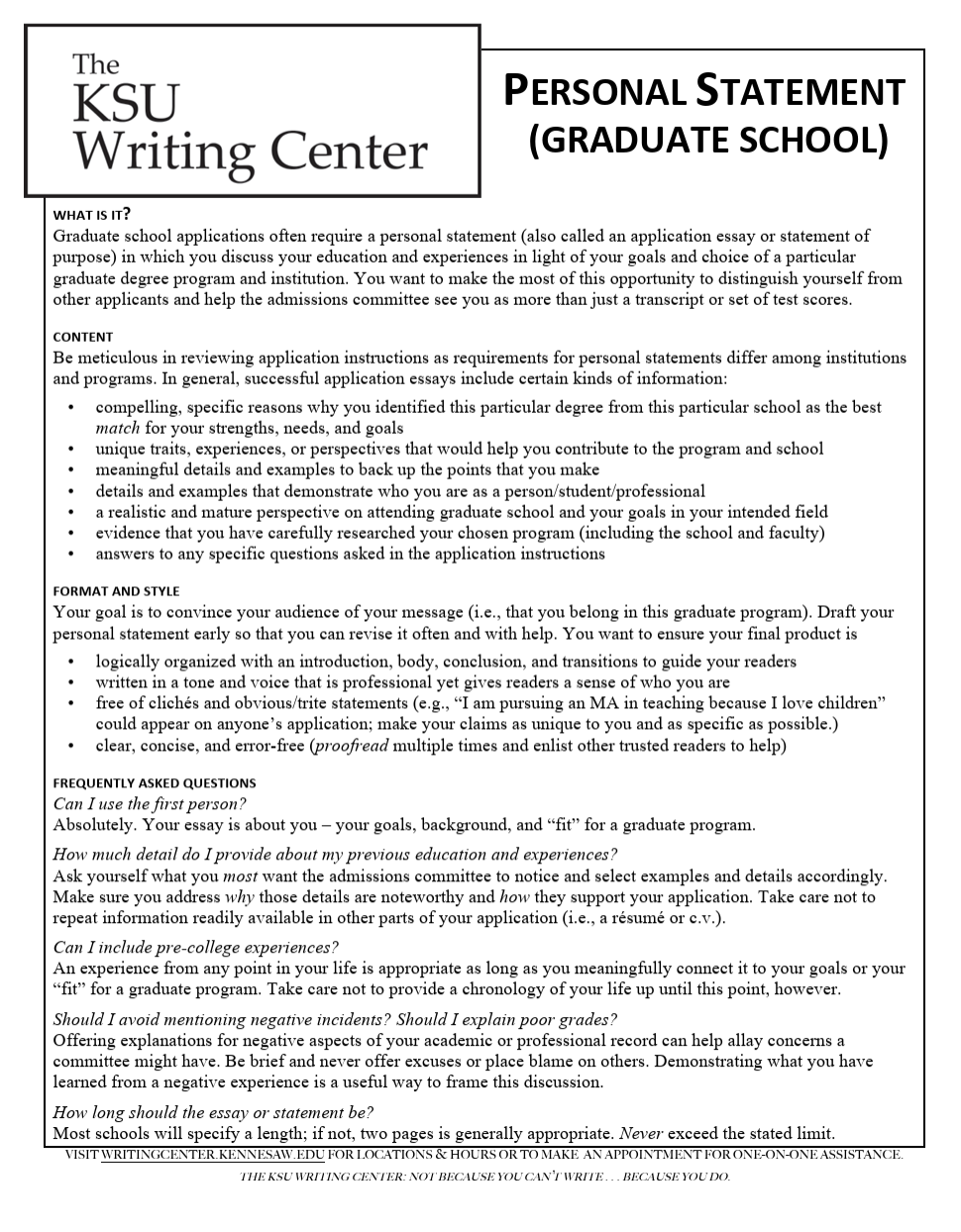
A personal statement is your chance to show an admissions committee who you are beyond your transcript and test scores. It explains your goals, the experiences that shaped them, and why this program is the right next step. A strong statement is specific, focused, and written for the program you’re applying to.

A screenshot of the personal statement guide.
personal statement guide

From the KSU Writing Center

Start Here: Read the Prompt

Before you write anything, read the application instructions closely. Every program asks something a little different, and your statement must answer the question they ask. A beautifully written essay that misses the prompt won’t do you any favors.

As you review the instructions, look for:

  • What they’re asking for. Some programs want a personal statement (your background, motivations, and story). Others want a statement of purpose (your academic and research interests and career plans). Some ask for both. If you’re not sure which one you’re writing, ask the program.
  • Specific questions to answer. If the prompt lists questions, answer every one.
  • Length and format. Follow the word or page limit exactly. If no limit is given, about two pages is a good guideline. Never go over the stated limit.
     

What Admissions Committees Want to Know

Prompts are worded differently, but most are trying to learn the same four things:

  1. What do you want to study?
  2. Why do you want to study it?
  3. What experience has prepared you for this field?
  4. What do you plan to do with your degree?

They’re looking for clear goals that grow out of real experience, and for evidence that you’ll stay committed through a demanding program. Being direct and substantive beats being flashy.


Questions to Ask Yourself (Before You Start Writing)

Use these questions to brainstorm. You won’t use every answer, and that’s the point. Once you’ve gathered your ideas, choose the ones that best answer your program’s prompt and tell your story most clearly.

Why this path?

  • What inspired you to pursue graduate or professional school?
  • Was there a moment, class, or experience that sparked your interest?
    • Example: “After volunteering at a local clinic, I realized I wanted to combine my biology background with community health outreach.”

What drives your curiosity?

  • What topics, questions, or problems in your field excite you most?
  • How do you hope to contribute to this area?
    • Example: “I’m fascinated by how language shapes identity, and I want to explore this through sociolinguistic research.”

How have you prepared?

  • What coursework, jobs, internships, or research have helped you grow?
  • What skills or insights have you gained, and how will you use them in graduate school?
    • Example: “As a data analyst intern, I learned to translate complex findings into actionable insights, a skill I’ll carry into graduate research.”

What challenges have shaped you?

  • Have you overcome obstacles that affected your academic path?
  • Is there context behind a dip in grades or a gap in your résumé?
  • Keep it brief. Explain without making excuses, and focus on what you learned. You don’t need to share anything you’re not comfortable sharing.
    • Example: “Balancing school with caregiving responsibilities taught me to manage my time and stay focused under pressure.”

Why this program?

  • What about this specific program fits your goals: its courses, research areas, resources, or approach?
  • Are there faculty whose work connects with your interests? (Check their recent publications, and whether they’re currently taking students.)
    • Example: “Dr. Chen’s research on urban sustainability closely matches my own goals, and I’m eager to contribute to her lab.”

Where are you headed?

  • What do you plan to do with this degree?
  • How will this program help you get there?
    • Example: “I plan to work in public health policy, and this program’s focus on community-based research will give me the skills to design programs that reach underserved populations.”

What do you want them to remember?

  • What qualities or values define you?
  • How do your experiences show your potential as a graduate student?
    • Example: “My curiosity and collaborative approach have helped me thrive on interdisciplinary teams, and I’m excited to bring both to this program.”

Do's and Don'ts

DO:
  • Answer the prompt: Make sure every paragraph supports what the program asked.
  • Tell a story: Use specific examples to show your interest and growth.
  • Be selective: Choose a few experiences that show you’re ready for graduate-level work, like research, demanding coursework, teamwork, or teaching.
  • Stay positive: If you mention setbacks, focus on what you learned and how you’ve grown.
  • Keep it concise: Stay within the limit and make every sentence count.
  • Tailor it: Customize your statement for each program. You can reuse your core experiences, but change how you present them to fit each one.
DON’T:
  • Use clichés: Statements like “I’ve always wanted to help people” may be true, but they could appear on anyone’s application. Show it through a specific experience instead.
  • Repeat your résumé: Your résumé already lists your experiences. Your statement should go deeper on a few and explain why they matter.
  • Include unrelated details: Hobbies and activities belong only if they connect to your goals or your readiness for graduate study.
  • Use overly dramatic or vague language: It can confuse the reader and distract from your message.
  • Make excuses or place blame: When explaining a challenge, own it briefly and move to what you learned.
  • Bring up controversial topics: Unless they’re directly relevant and handled thoughtfully, they shift the focus away from you.

Final Tips:

  • Start early: Give yourself time to write several drafts.
  • Take breaks: Step away from your draft before you edit so you can read it with fresh eyes.
  • Get feedback: Ask a professor (ideally one writing your recommendation), a mentor, or a Career Planning advisor to review your content.
  • Proofread: Read it aloud and have someone else check it too. Typos and grammar mistakes can distract from your message.