What Is Negotiation?

Negotiation is when two people or groups talk about what they want and try to agree on something that works for both. You might negotiate with a boss, a company, or a supplier. You can even negotiate your first salary — and you should.

The Offer Is a Starting Point, Not the Final Word

When a company posts a job, it usually has a salary range in mind, not a single number. The first offer typically lands in the lower or middle part of that range, and employers expect you to respond. Hiring managers budget for it. Recruiters are trained for it.

That means if you accept the first number with no questions asked, you may be leaving money or benefits on the table that the company was already prepared to give you. Asking doesn't make you look ungrateful or difficult. It shows you understand your value and how the process works.
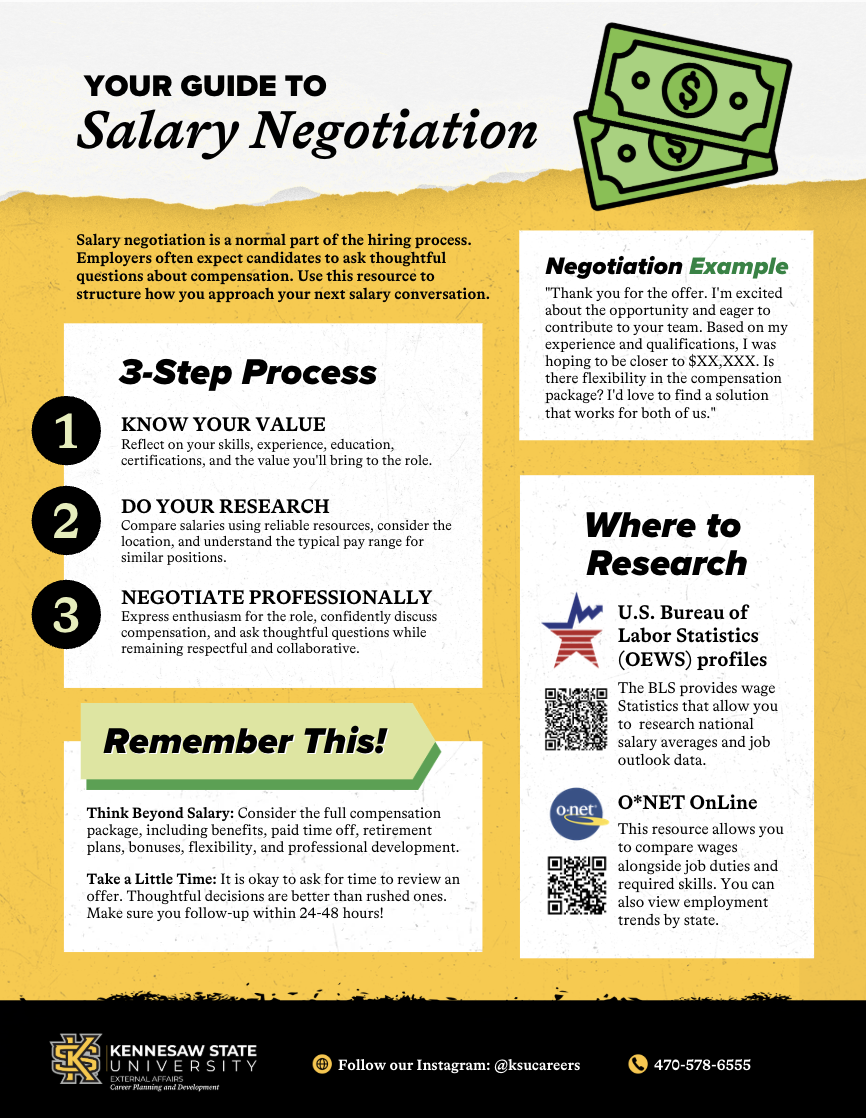
How to Negotiate a Job Offer


  • Before you start, make a list of what matters to you: pay, work hours, vacation time, remote or hybrid options, job duties, growth opportunities. Rank them. Decide what's most important and where you're willing to be flexible.

  • Find out what others in similar roles, in your location, are being paid. Use sites like Glassdoor, Levels.fyi, and the Bureau of Labor Statistics, and ask people who've worked in that field. Knowing the market range gives you a number you can back up.

  • Don't negotiate during the interview. Wait until you have a written offer in hand. That's when you'll see the full pay and benefits package, and when it's expected that you'll ask questions or request changes. If you're asked for salary expectations earlier, it's fine to say you'd like to learn more about the role first, or to give a researched range rather than a single number.

  • If the offer seems low or you bring skills the role values, ask for more. A request of 5–10% above the offer is a reasonable starting point. Be polite, be specific, and explain why: your research, your experience, a competing offer, or a skill that's hard to find.

    • What it can sound like: "Thank you so much for the offer. I'm excited about this role. Based on my research and my experience with [skill], I was hoping for something closer to $[X]. Is there any flexibility on the base salary?"
  • The company might say yes, no, or offer something different. Listen carefully and take time to think. You don't have to answer on the spot. Ask for a day or two to review. You might not get everything you ask for, but you could still end up with a better deal than you started with.

  • Salary isn't the only thing on the table. If the company can't raise your pay, ask about:

    • Signing bonus
    • More vacation days
    • Flexible or remote work hours
    • Help with moving costs
    • Student loan repayment assistance
    • Professional development or tuition support
    • An earlier performance review with a chance for a raise
  • Once you agree, ask for an updated offer letter that reflects the changes. Then accept. A verbal "yes" is a good sign, but the written offer is what counts.

When Not to Negotiate

Sometimes it's better not to push. For example:

  • Many government and some union jobs have fixed pay scales. You can still ask about start date, schedule, or which step of the scale you begin at.
  • If the offer already meets or beats your research and your priorities, you may not need to change anything. Don't negotiate just for the sake of it.
  • If the offer is far below what others are paying and the company won't budge, it may be better to decline and look elsewhere.
  • If you've already accepted, the window has closed. Negotiate before you say yes

Why It Matters

Your first salary sets the baseline for future raises, promotions, and offers from other employers. Even a few thousand dollars more at the start can add up to a significant difference over a career. And the more you practice, the more natural it feels. Learning to negotiate now builds a skill you'll use for the rest of your working life.

Want help practicing your negotiation skills or figuring out what to ask for? Schedule an appointment with a career advisor at the Department of Career Planning and Development. We're here to help you succeed.