KENNESAW, Ga. | Nov 18, 2026
Engineering research can take shape in the design of new materials, improvement of existing systems, and the development of innovative solutions to real-world problems.
Engineering research can take shape in the design of new materials, improvement of existing systems, and the development of innovative solutions to real-world problems. That work extends from university laboratories to national research facilities and industry settings, where researchers collaborate to solve complex challenges.
For some doctoral students at Kennesaw State University, the GEM Fellowship is creating pathways to explore these professional research environments firsthand. Edgar Bryant and Mechack Nduwa, both pursuing a Ph.D. in Interdisciplinary Engineering, are the university’s first GEM Fellows. Through the fellowship, they are gaining access to a nationwide community of professionals, while receiving financial support and paid summer internships that connect academic research with real-world applications.
Bringing the fellowship to KSU was a personal endeavor for Dr. Aaron Adams, professor of engineering technology, and currently the interim department chair for the Southern Polytechnic College of Engineering and Engineering Technology. As a former GEM Fellow, Adams wanted KSU students to benefit from the same opportunities that had been part of his own experience. “I wanted KSU students to have access to that national network of universities, industry partners, and national laboratories,” Adams said. Through a collaboration between the Graduate College and the Southern Polytechnic College of Engineering and Engineering Technology, that opportunity has become a reality. “Creating such opportunities is key to building graduate student success at Kennesaw State University,” says Juliet Langman, Dean of the Graduate College.
Adams believes KSU students have the talent to succeed in advanced engineering and science careers and wanted to ensure they viewed graduate education as an achievable next step toward those goals. For Mechack and Edgar, that opportunity marks the beginning of a new chapter in their doctoral journeys.
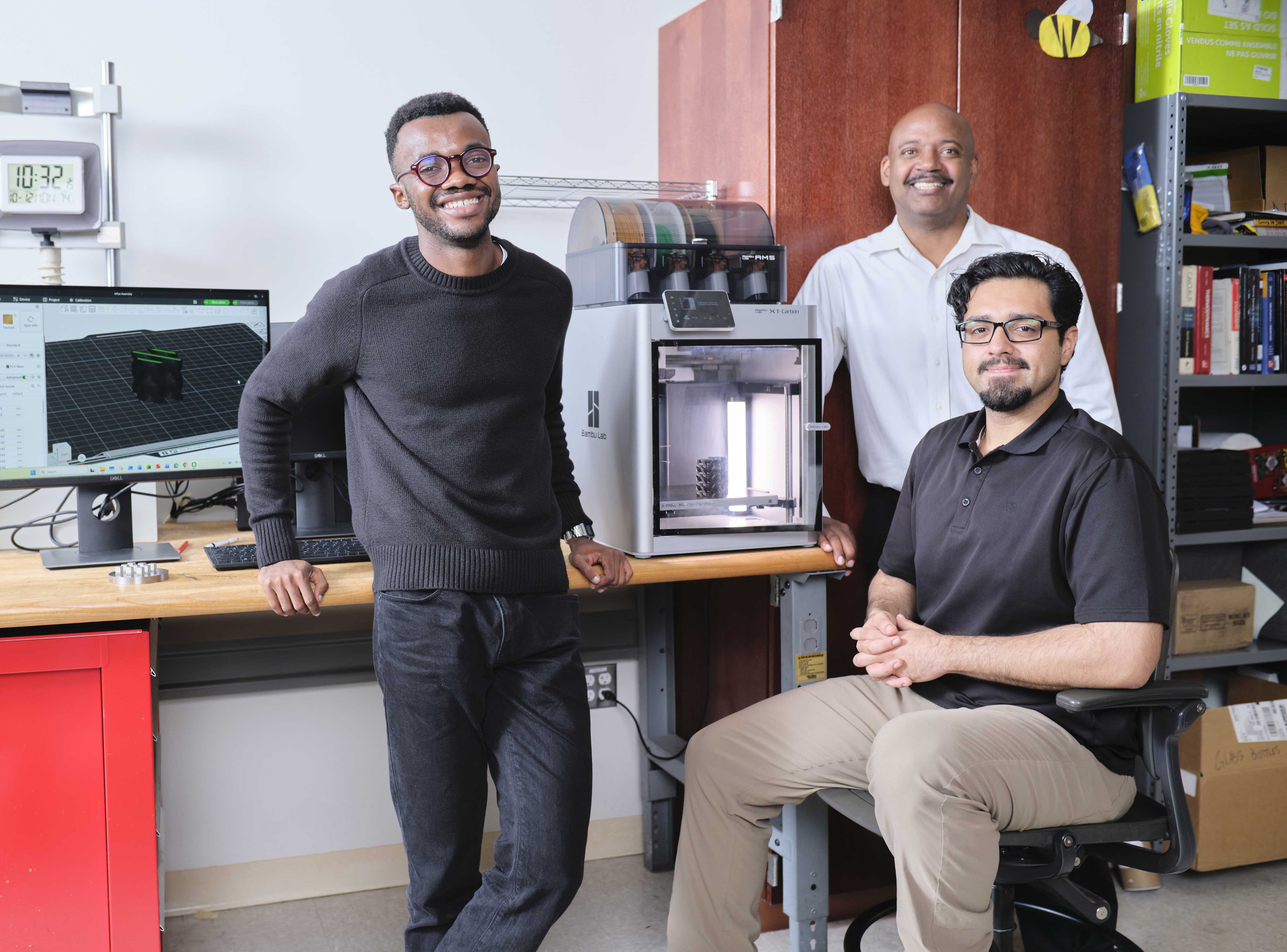
When Mechack was still an undergraduate at KSU, he wasn’t sure research was something he would enjoy. To challenge himself, he joined Dr. Aaron Adams’ research team. “I quickly realized that I enjoyed not only understanding how things are made but also asking why materials behave the way they do and how we can improve manufacturing processes,” he recounted.
That experience reshaped his view of research and inspired him to pursue a Ph.D. in interdisciplinary engineering at KSU. “The program really appealed to me because the problems I am interested in do not fit neatly into one discipline,” Mechack said. “My work brings together manufacturing, materials science, corrosion, mechanical behavior, and characterization.”
For Mechack, the GEM Fellowship represents more than financial support for graduate study. “Many fellowships support the academic side of graduate school,” he said. “But GEM also gives students an opportunity to develop professionally through industry and national laboratory experience.” Langman agrees; “the Gem Fellowship provides critical opportunities for industry specific work experiences that align with the student’s research interests and can be a powerful springboard to a career post-graduation.”
For the past two summers, Mechack completed internships with Idaho National Laboratory (INL), where he contributed to research on advanced nuclear materials and manufacturing. INL is one of seventeen national labs in the U.S. Department of Energy complex, where researchers investigate materials that can withstand extreme environments.
Mechack’s two internships gave him an opportunity to build on his initial experience and take on more challenging work. “The first summer introduced me to the materials through characterization,” he explained. “The second allowed me to become more involved in actually producing and processing those materials.”
The work also showed him how individual research projects can contribute to broader scientific and technological goals. “At INL, I could see how materials characterization, manufacturing science, and fundamental research connect to much larger questions surrounding nuclear energy and advanced reactor technologies.”
For Edgar Bryant, the appeal of GEM extended beyond research opportunities. He valued the fellowship’s combination of academic support and professional development, which aligns with his goals for the future. “Becoming a GEM Fellow was a major milestone for me, especially as a first-generation college student. I liked that it wasn’t just focused on helping students earn their degree but also prepared them to become engineers and researchers.”
Edgar, whose academic research explores how different manufacturing and post-processing conditions affect a material’s performance in a nuclear environment, also completed two summer internships at INL. Those internships allowed him to apply his interests in a national laboratory setting. He felt most challenged at the beginning of his internship, when he had to adjust from the classroom to a research environment in a national laboratory. He said, “In the classroom, you’re typically working toward an answer that already exists, but in research, you’re often investigating questions that don’t have a clear solution.” It was while he was at INL that he learned that research doesn’t always go as planned. “Sometimes the most valuable information comes from understanding why something didn’t work as expected,” he added.
“I see Mechack and Edgar as strong representatives of GEM because they are using this opportunity to grow as researchers and engineering professionals,” said Adams. “Their progress also gives other students a tangible example of what is possible: a KSU undergraduate education can lead to doctoral research, national laboratory opportunities, and participation in work that addresses important engineering challenges,” he further explained.
Having GEM Fellows at KSU expands access to advanced STEM research and professional networks for a broader range of students. “I see GEM as an investment in the people who will advance KSU’s research ambitions. Supporting their recruitment, development, and degree completion contributes directly to the research capacity we need as we pursue R1 status,” said Adams.
As KSU’s first GEM Fellows, Mechack and Edgar are helping establish a foundation for future students who pursue the fellowship, and through research and professional experiences, they are discovering new possibilities for their careers. Their journeys illustrate how the GEM Fellowship can help eligible students advance their education and prepare for careers in engineering and related fields.
By Tracy Gaudlip