


KENNESAW, Ga. | Nov 24, 2026
He nearly lost his firm in its first year, and other people helped him keep it. Now the Five in Flight honoree gives Kennesaw State students the same kind of start.
The $50 came from his sister. It had to last.
In early 2013, David Nicholas pushed a grocery cart down the aisles with his mother beside him. He was a few days out of the hospital after one of his lungs collapsed. The financial practice he had opened a year earlier had spent every dollar he'd saved. His bank account was overdrawn, and he was living in his mother's house again.
He headed for the ramen and the beans. She headed for the produce and filled the cart with apples and grapes.
"Mom, what are we doing?" he asked.
"You need healthy stuff," she said.
He pushed back. "Mom, I have $50 to survive," he told her. "I'm getting ramen noodles. We're loading up on beans. I'm not getting fruit."
To him, an apple was a luxury.
"The thought of even buying an apple was not even part of my vocabulary," Nicholas said. "We were just in survival mode."
His mother was shopping for a son who would get well.
That grocery trip later became a family joke. It also holds something Nicholas learned about building a business. Even when he was determined to make it on his own, other people kept him going.
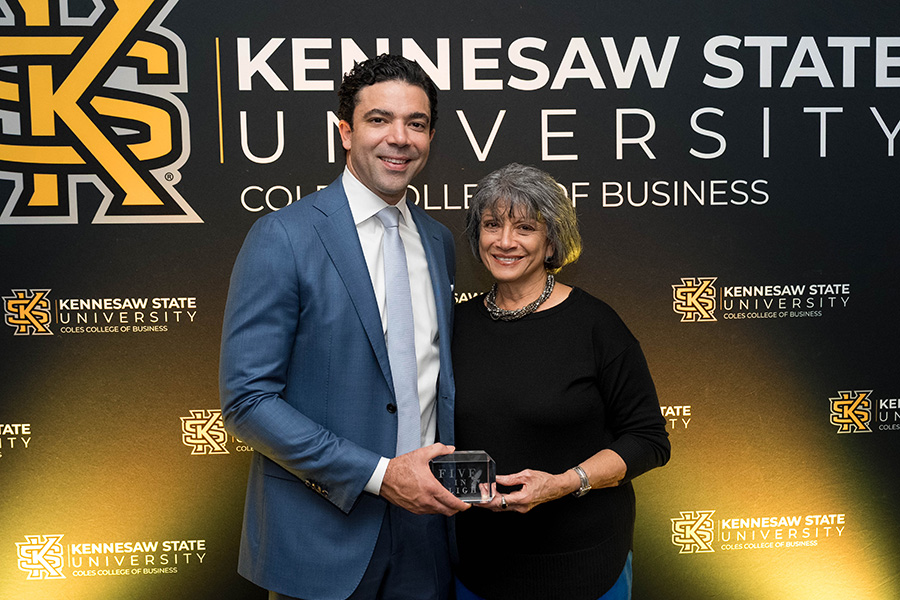
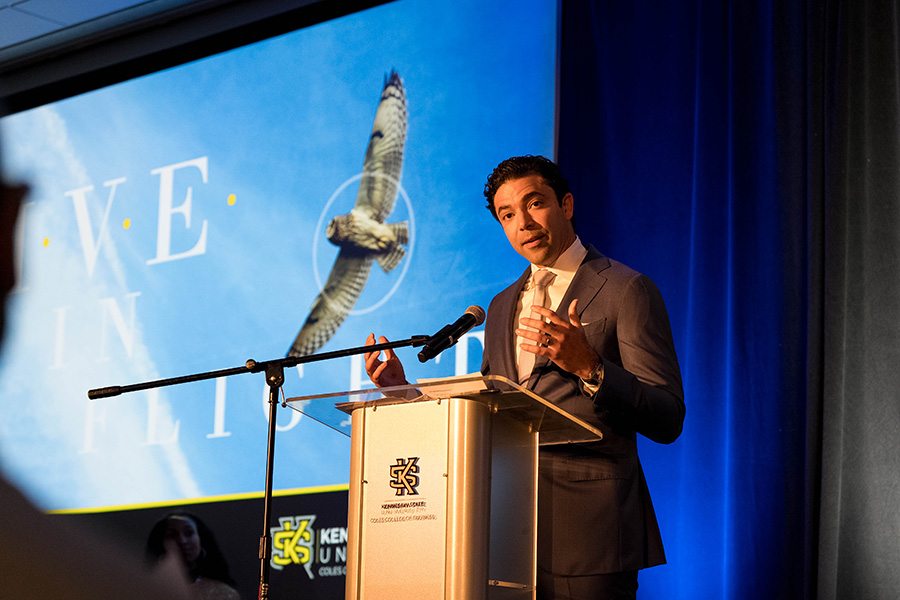
He did get well, and so did the business. It grew into Nicholas Wealth Management, a Marietta firm with 23 employees. Several are Kennesaw State graduates who started as interns, just as Nicholas did. He hosts "Retire Ready" on WSB radio and is a regular guest on Fox Business. On Oct. 29, the 2009 Kennesaw State University finance graduate received the Distinguished-Career Entrepreneurship Award at Five in Flight, the alumni awards of the Michael J. Coles College of Business.
He knew early what he wanted to be. He grew up in Fort Lauderdale, Fla., where his best friend was a boy named Derek, whose father managed portfolios at Templeton, the investment firm.
"I always said, whatever Derek's dad does, that's what I want to do when I grow up," Nicholas said.
Nicholas’ own family had less. He was the youngest of three, raised with two older sisters by a single mother who worked as a secretary. Barely earning enough to cover their living expenses, she still sent her children to a private Christian school by asking for scholarships and having her son work summers at the school.
Her boss made room for them, too. When his mother had to pick the children up from school, her boss let them come back to the office and do their homework in a back room. Nicholas said that boss is part of why he wanted to run a business of his own.
When he was 13, she bought each of her children a few shares of stock. She knew little about investing, but she wanted them to learn. Nicholas picked Lucent Technologies. When the tech bubble burst, the stock collapsed, and he lost it all.
"Learned the hard way on that one," he said.
It got him thinking about money anyway, and about saving for the future. That same year, his mother took a better job in Atlanta, and the family moved north.
He found two mentors in college who left a lasting impression. The first was Luc Noiset, who taught him economics at Kennesaw State in a couple of classes.
"He really is the one that kind of got me really interested in economics, really excited about it," Nicholas said.
The second he met during his internship. In 2005 while still a finance student, Nicholas joined Ty J. Young Wealth Management in Atlanta. Before long, he said, "I was spending more hours working than I was doing school."
The owner, a 6-foot-5 former Georgia Tech football player ran the office like a drill sergeant. Show up late, and you dropped for push-ups.
"It was exactly what I needed as this 18-year-old kid that had no discipline," Nicholas said.
The owner, who had come from Bear Stearns, taught Nicholas that an advisor can win clients by spending time or by spending money. Time meant networking, one handshake after another. Money meant dinner seminars, radio and television, which reach people a handshake never will.
"I can't scale time," Nicholas said.
In the fall of 2008, Lehman Brothers collapsed and markets fell for months. Nicholas graduated in 2009 with a job already waiting at the firm.
"Most of my friends that were graduating in '08 and '09 in finance couldn't get jobs," he said. "Brutal year for the markets, but good because the internship, I had a job."
By 25, Nicholas had spent seven years at the firm. He wanted more freedom than the job allowed, and he knew the window for that kind of risk would not stay open long.
"I'm 25 years old, I'm not married, I don't have kids," he said of his thinking then. "If there's any time in my life to take risk, it's now."
In February 2012, he went out on his own with no clients, no prospects, and about $30,000 in savings. He rented space in a shared office suite. In the lobby, his prospects sometimes sat beside a criminal defense attorney's clients, ankle monitors and all.
He bet on dinner seminars. They brought in almost nothing. By December the money was gone. That June, he had started dating Kristin, now his wife, and he was still driving a sports car "that I had no business driving at the time." He gave up his townhome and moved back in with his mother, car and all.
"Mom, can you park outside so I can park my car in the garage?" he asked her.
She was, he said, his biggest cheerleader.
In February 2013, his lung collapsed. In a hospital room, he broke down.
"I remember this moment of just literally crying, and it's kind of embarrassing," he said.
The rescue came through his mother. A friend from her Sunday school class needed a financial advisor. The account turned out to be a large one, and it gave Nicholas enough room to hire his first employee and move into a real office.
"The irony is all the stuff that I did pretty much failed, and the one thing really that was out of my control helped," he said.
The turn came on the radio. Nicholas called WGST, then on 640 AM, and pointed out that the station had no financial advisor on the air.
"I'd love to do that," he told them. "I feel strongly that I can do it."
The show went on the air in late 2013, and the phone started ringing.
His first national television appearance as a guest came in January 2018 [confirm], opposite Fox Business anchor Maria Bartiromo. He was so nervous that he memorized every talking point and recited them all before she asked a single question.
"So needless to say, that did not go well," he said. "The producers weren't happy. They told me to never do that again."
They moved him to the 5 a.m. show, and for a year and a half he woke at 3 to make it. Today he is a regular guest on "Varney & Co." The firm has grown, too, into investment management through XFUNDS, the exchange-traded fund company Nicholas founded.
Some of the clients who waited in that shared lobby are still with him.
"Those clients trusted me when I didn't really give them a whole lot of reason to," he said.
Now Nicholas makes room for others.
The firm's office sits about 15 minutes from campus, and he hires KSU students as interns, usually as sophomores or juniors. Because they live nearby, many keep working through the school year, not just for a summer.
Steven Waltz joined as a new business intern in 2024. He moved into client service, and, after earning his KSU degree in business management this year, he became a full-time trading associate. Ashlin Smith and Bekah Thomas, both KSU graduates, work in marketing. Jared Chambers a financial advisor and KSU finance graduate recently celebrated 5 years with the firm. Logan Pritchett, a KSU finance graduate, is a client service coordinator.
"Just how I did it, right?" Nicholas said.
For him, the internship is also the safest way to hire.
"Having that internship gets you in the door of a company, and it's great for the company," he said. "It's a lot for me to risk hiring somebody I don't know much about. They may look good on paper."
One recent KSU graduate on his team asked him how to learn more about finance. Read The Wall Street Journal, Nicholas told him. The print edition.
"Like the newspaper?" the graduate asked.
"Trust me on this," Nicholas told him. "When I'm done reading it, I set it out there. Go grab it, and just read it."
His advice to Coles students with little money and no connections is blunt.
"If you want to build something great it's just going to be very hard and that's okay," he said.
What kept him going in 2013, he said, was a simple goal.
"Maybe if I make it one day, I can give my mom a good life," he said.
It never stopped with her.
"I can bless my mom, I can bless my family, I can bless my clients, I can hire people," he said.
He and Kristin are raising two daughters and a son in Marietta. On Sundays, they go to church and then to lunch with his mother.
He grew up with a single mother and two older sisters, and now he is raising two daughters.
"I had been surrounded by just strong, amazing women," he said.
He measures success by them first.
"For me, success is that I honor my mom," Nicholas said. "I have a great relationship with my wife, and I'm a great dad to my kids. If I can do all that and build a great business along the way, then there's really not much more success I think that you can find in life."
He hasn't forgotten the grocery store, either. Neither has his mother.
"Whenever we have apples," he said, "we talk about that."
Story by Andy Mann
Veterans find community, opportunity, and support at Kennesaw State

In The News: Kennesaw State Expands Role in Atlanta's Fintech Talent Pipeline
How an Executive MBA friendship made Kevin L. Williams a mentor to Kennesaw State students
Troy Rice bet on himself at Kennesaw State. He came back as a CEO to bet on its students