KENNESAW, Ga. | Sep 3, 2026
Why AI begins long before artificial intelligence is talked about

Organizations don't become intelligent because they adopt AI. They become intelligent because they modernize. AI simply amplifies what their infrastructure has finally become capable of doing." AI Leadership Compass, Lead with Clarity
Priya Sarathy, Ph.D, CDMP, AIGP
Educator| Author| AI & Data Thought Leader | Non-profit Board Member | Nature Lover | Mentor, Speaker, AdvisorOver the last six months, I have written about what AI leaders should be thinking about. But I keep returning to a more foundational question: are we focusing too much on AI itself and not enough on the modernization journey that makes AI useful?
Growth and productivity do not come from models alone. They come from workflows, data, and operating models that have evolved enough for AI to amplify them. In 2026, I found myself navigating three very different systems. On the surface, they have almost nothing in common. Yet every one of these experiences left me thinking about AI. Ironically, none of them taught me anything new about artificial intelligence. They reminded me of something much more fundamental.
That realization became clearer as I reflected on three transportation systems: the New York subway, Indian Railways and Norfolk Southern. They operate at different scales, serve different customers and solve different problems. Yet all three reveal the same truth:
Modernization comes first, AI comes second.
Over the next three newsletters, I'll explore three organizations that solved very different problems—but arrived at the same lesson. AI created value only after decades of modernization had quietly transformed their operations.
Modernization may be the chapter I did not call out clearly enough in my book - AI Leadership Compass: Lead with Clarity. The AI transformation conversation often misses the real source of momentum behind AI success: the operating environment that existed before AI arrived.
When organizations begin their AI journey, the conversation usually starts with models.
They're important questions. But they often skip an even more important one.
The organizations extracting the greatest value from AI today didn't start with AI. They started years earlier by modernizing how work gets done.
AI needs an ecosystem that can support it before it can perform. Having AI doesn't magically eliminate friction. It learns from the digital infrastructure already in place. It cannot contextualize disconnected information. It performs only as well as that infrastructure allows. That means organizations need
Without those foundations, AI simply makes inefficient processes happen faster.
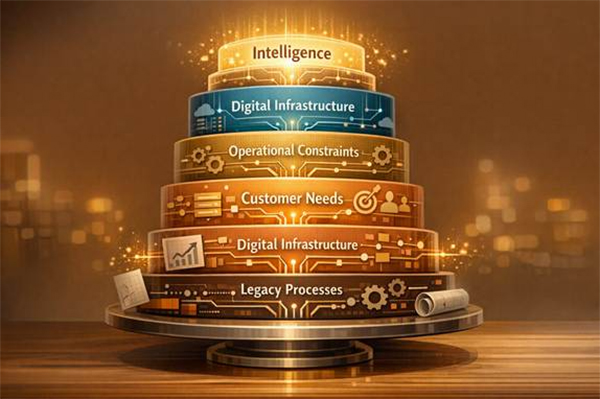
Three Experiences That Changed My Perspective
The three examples that I provide are not transportation case studies. They are modernization stories. Each one shows how value emerges when legacy processes, customer needs, and operational constraints lead to redesigning the infrastructure before intelligence is layered on the top.
The New York Subway
In New York, a tap replaced the MetroCard ritual. The transformation was not the contactless reader itself. It was years of payment modernization, system integration, fare-policy redesign and operational change that delivered value through a frictional less experience across 1.195 billion annual rides in 2024.
The tap is not the transformation. It is the point at which the customer finally experiences the transformation.
Indian Railways
In India, digital reservations made a vast and complex passenger network more accessible. The visible change was the booking experience. Beneath it sat decades of standardization, integration and operational redesign.
Railways are also personal to me. My father’s work in track modernization taught me early that operating intelligence begins with physical signals, like sound, movement, vibration, weather and physical condition—long before those signals become digital data.
My recent experience with Indian Railways reminded me what modernization can achieve in scale. The scale is mind-boggling: Indian Railways supported approximately 7.4 billion passenger journeys during 2025.
Norfolk Southern
In freight rail, modernization is largely invisible. Sensors, inspection systems and AI models help identify risk while trains remain in motion. They are quietly preventing problems before they occur. The contribution of intelligence powering AI is rarely visible to the public. They communicate early warning signals about emerging problems so teams and operating systems can react early to mitigate risk.
Each system demonstrates a different outcome of modernization:
Different systems. Different outcomes. The same underlying principle: intelligence creates value only when the operating environment is ready to use it.
As I reflected on these experiences, a pattern emerged. Talking about how to operationalize AI is one thing; seeing modernization unfold across transportation systems shows how leaders create the conditions for AI to operate at scale.
None of these organizations began with AI. They evolved as new technologies, customer expectations, operational pressures, and delivery pain points created a need to modernize. Over time, they built on the strengths of earlier platforms and focused on one priority-
As I reflected on these experiences, a pattern emerged. Talking about how to operationalize AI is one thing; seeing modernization unfold across transportation systems shows how leaders create the conditions for AI to operate at scale.
None of these organizations began with AI. They evolved as new technologies, customer expectations, operational pressures, and delivery pain points created a need to modernize. Over time, they built on the strengths of earlier platforms and focused on one priority- They modernized:
AI transformation is not an event. It is the visible outcome of years of modernization. That view is echoed in a World Economic Forum white paper:
AI’s next phase demands a rethinking of core workflows to unlock enterprise-wide impact, rather than an expansion of pilots
Organizational Transformation in the Age of AI
How Organizations Maximize AI’s Potential, March 2026, p. 6.From my viewpoint, I see modernization as a progression, not a technology project. It is less about adopting tools and more about building the conditions that allow intelligence to create value.
Modernization Ladder
Digitalization → Standardization → Integration → Context → Intelligence → Personalization → Autonomy
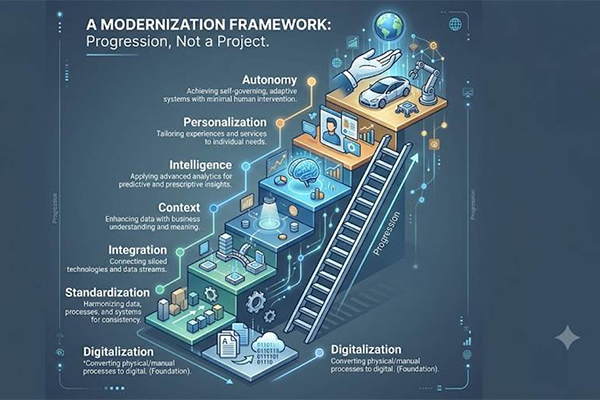
Notice where intelligence appears. Not at the foundation, but only after digitalization, standardization, integration, and context.
Foundational requirements must be established first. They give the ladder strength and stability. Everything beneath intelligence enables everything above it. AI cannot personalize what it has not understood. It cannot optimize what is not connected. It cannot automate what has not been standardized. Intelligence does not create value until it changes a decision or action.
Key Takeaway: Modernization creates more than digital infrastructure. It creates operational memory—the accumulated knowledge embedded in transactions, workflows, customer interactions, and organizational decisions. AI doesn't create that memory. It inherits it. The quality of what AI produces therefore depends on the quality of what the organization has learned to capture, connect and retain.
Previously, I have written about AI adoption, AI fluency, and context engineering. Context does not appear by accident; it emerges from modernized systems. Personalization does not happen because of better prompts. It happens because organizations have created an environment where AI has access to the right information, at the right time, within the right business process.
Prompts help search, analyze, and execute the commands we present; they do not replace the foundations that make reliable, original work possible.
The question we keep asking may be too narrow.
Instead of asking only, “How do we scale AI?” leaders should ask, “What must the organization become capable of doing before AI can scale?”
Organizations leading with AI are not necessarily leading because they adopted better models. Many are leading because they modernized earlier.
This article introduced three experiences that changed how I think about modernization and AI readiness.
Over the next couple of months, I will unpack each story individually and explore what it reveals about:
Final Learning point: AI does not create organizational intelligence. It amplifies the organization’s existing capacity to turn signals into context, decisions and action.
Reference: AI Leadership Compass, Chapter 16, “AI Value and Impact,” and Chapter 12, “Tech-as-a-Service: The AI Backbone.” AI Leadership Compass: Lead with Clarity: 7 Moves That Power AI Transformation: 9781736706985: Sarathy PhD, Priya: Books