KENNESAW, Ga. | Feb 26, 2026
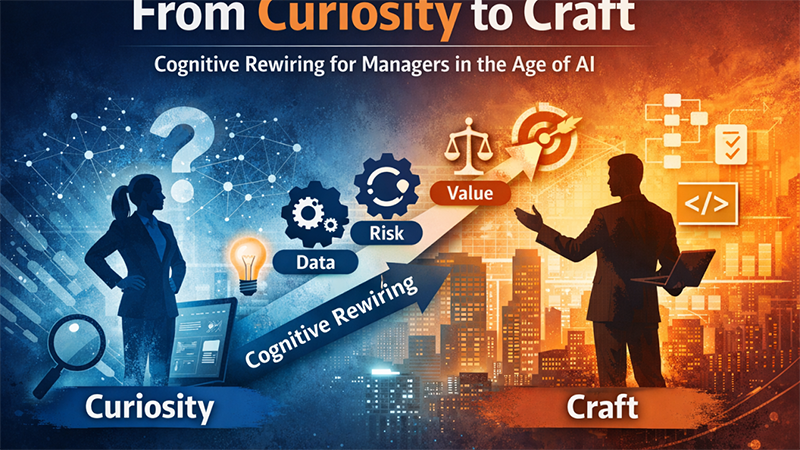
Career transitions. Missed promotions. Teams struggling to “use AI better.” These aren’t student problems anymore. They’re management problems. Across industries, I’m seeing the same quiet tension:
And many capable professionals are asking: Why isn’t experience translating the way it used to?
The answer is not the lack of skills. It is about the lack of cognitive rewiring. The path to achieving that starts with improving AI fluency awareness.
When Stephen Covey spoke about “sharpening the saw,” he wasn’t talking about efficiency. It was about renewal and focusing on tasks that support our goals. It meant strengthening relationships, communication, and leadership skills. Today, sharpening the saw includes building a new kind of relationship with AI.
And that requires more than curiosity. It requires intentional fluency. Curiosity to learn about:
By rewiring how we perceive, understand, and respond are dormant skills that we are rediscovering.
AI fluency is not adding a tool. It is evolving how we think about the tools, it's use, its outcome or the value it can deliver.
Manager Tip: If you are learning new AI tools but not changing how you frame business
problems, you are upgrading software but not upgrading leadership.
McKinsey reports that over 50% of organizations now use AI in at least one business function. Yet only a fraction report material financial impact.
Why?
Because adoption is not fluency. Most managers are still interacting with AI downstream. In meetings they are presented with dashboards, informed about automation or “AI-enabled” features. They respond operationally. We need to rethink our responses. Not because the fundamentals of value have changed. But because the expectations of speed, scale, and risk have been restated by leadership. We need to ask ourselves:
“How should we redesign our approaches to business problems?”

Think of AI fluency as a fork in the road. You must make a choice. For example, similar to the choice the protagonist had to make in the movie Sliding Doors, how would you react when an AI project is introduced?
Scenario A: Do you ask about the timeline and delivery for the project as you are focusing on the outcomes?
Scenario B: Do you ask more questions?
Same meeting. Same model. Different trajectory.
This is not about having or not having technical depth. This is cognitive positioning.
Before generative AI became mainstream, career advancement followed a familiar path: Deep domain expertise was built working in the lower rungs of an organization. Gradual layering of experiences developed your analytics capability. Managing the usability of the product you build based on the value it can generate or understanding the platform and process to become more effective. You learnt and worked on mastering these skills.
The environment was structured. Typically, business problems were scoped. The technology stack was controlled by Enterprise guidelines. Acquiring the mastery and experience in the environment translated to the message that “skill accumulation led to career mobility”.
But between 2022 and 2025, something changed. Generative AI tools collapsed technical barriers. Suddenly:
LinkedIn reported a 74% increase in AI skills added to profiles between 2022 and 2024. We were not prepared for the speed of changes. The innovation speed increased faster than our judging skills. We were told of the possibility, but we were overwhelmed by the choices!
What did the new learning curve look like?
Managers were suddenly overseeing tools they didn’t fully understand, while their teams experimented in fragmented ways. This created:
Tool fatigue, FOMO-driven experimentation, Governance gaps, False confidence
The managers who struggled were those who saw AI as a feature. The managers who adapted, by rewiring their behaviors, saw AI as a decision system.
Cognitive rewiring is not about learning to prompt. It is about shifting how you think about the same business problems. In my capstone class, I often reiterate – your roles are evolving about demonstrating the tools you know to having the ability to ask the questions to decide the tools you want to use.
Your role is no longer just delivery. It is orchestration.
As a manager, you must:
Examples of what we need to think about look like this,
1️⃣ Decisions: Instead of asking “Does this model work?” Ask: “What decision does this influence, and what is the cost of being wrong?”
2️⃣ Data: Instead of assuming outputs are neutral, ask: “What data path produced this result?”
3️⃣ Risk: Instead of treating governance as compliance overhead, ask: “How will drift be detected and managed?”
4️⃣ Value: Instead of celebrating automation, ask: “Did decision quality improve?”
Manager Advice: Evaluate one AI initiative this quarter across four lenses: Decision ownership, Data lineage, Risk mitigation, and Value measurement.
Final Thought
AI fluency is not about keeping up with tools. It is about managing ambiguity with confidence.
Same meeting. Same technology. Different trajectory.
And increasingly, that trajectory defines managerial relevance.