KENNESAW, Ga. | Dec 2, 2025
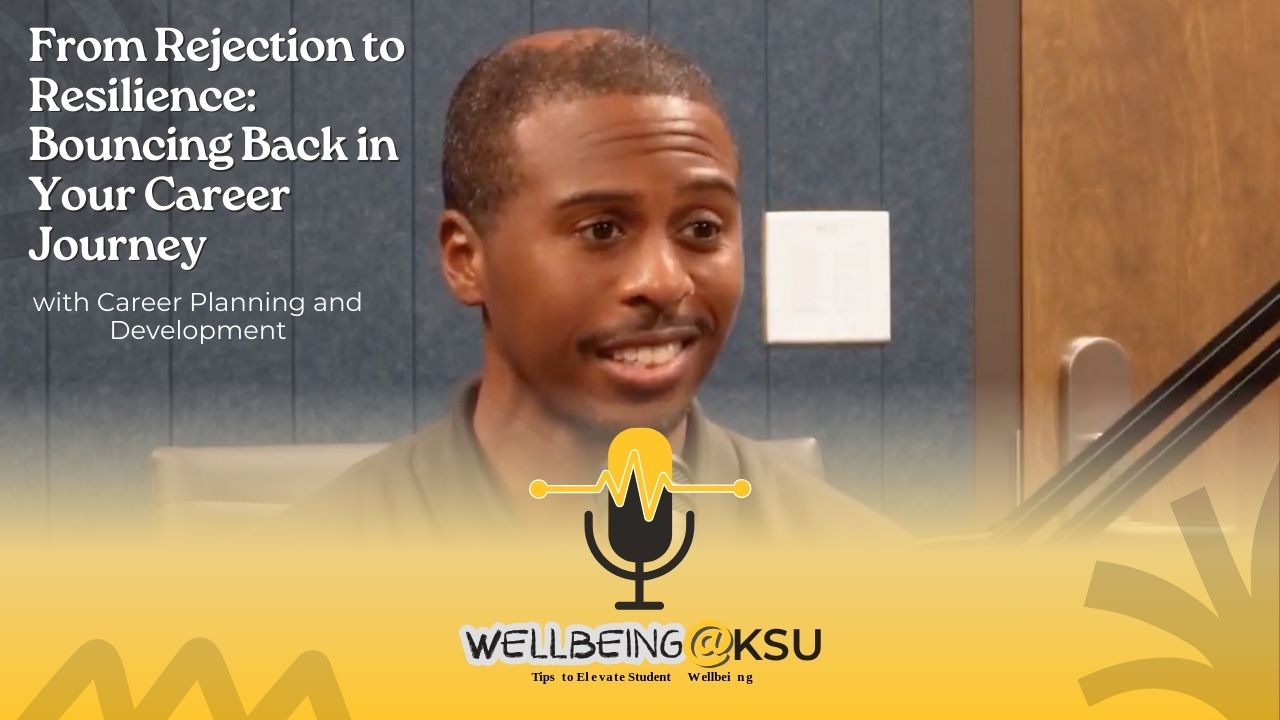
In this episode of the Wellbeing@KSU Podcast, we've brought in the Department of Career Planning and Development to discuss how to shift your mindset and cope with rejection while you're interviewing for jobs.
In this episode of the Wellbeing@KSU Podcast, we've brought in the Department of Career Planning and Development to discuss how to shift your mindset and cope with rejection while you're interviewing for jobs.
Oshun Tinker
Hooty Hoo Owls! Welcome to Kennesaw State University’s Wellbeing@KSU Podcast. I’m one of your hosts, Oshun, a marketing intern student with Health Promotion and Wellness. Today, we're talking about a topic that nearly every college student faces at some point: job rejection. Whether it's a missed internship, a “We went with another candidate” email, or simply being ghosted after an interview, it can take a real toll on your confidence and mental health.
In this episode, we will explore how to cope with rejection, shift your mindset, and build resilience in the face of career challenges. Joining us today are two guests from KSU's Department of Career Planning and Development, Anthony Holmes, Director of Career Advising and Planning, and Heather Owens, Associate Director of Career Advising and Planning.
Together, they bring a wealth of knowledge about what it takes to grow through rejection and come out stronger. Anthony and Heather, thank you for joining us to provide students and the KSU community with insights on how we advocate for them openly and behind the scenes.
Anthony Holmes
Thank you so much for having us. Happy to be here.
Heather Owens
Excited to get to chat with you guys.
Oshun Tinker
Of course! And to start, can you briefly describe the Department of Career Planning and Development, what you all exactly do, and what programs and services are available for students?
Anthony Holmes
Of course. So, we are a one-stop career shop, so we are there to meet all of the, all of the student’s needs. So, that can be resume review, looking at cover letters. If students are interested in applying to graduate school, we can help them with that process. Also, interview coaching. So, if you have this big, amazing opportunity coming up and you're just not sure what people are going to ask you, we can help in that way as well. We also facilitate internship credit. So, students, they get practical experience in the real world, and we can help them get academic credit for that.
Lastly, I would note that we also operate Handshake, which is our online job search portal. So, you can upload your resume there, create a profile, and hopefully get connected to employers and opportunities within the area and beyond.
Oshun Tinker
Okay, well, I think that’s amazing, because I did not realize you all handle Handshake as well as the internship credits. So, if a student does get an internship, they would go to the office or just email you all?
Heather Owens
Well, they'd want to connect with their career and internship advisor, and the best way to do that is to schedule an appointment through EAB Navigate. So that is the same platform that you use for your academic advisor. And you’ll just choose Career Planning and Development as the care unit instead of academic advising. And your career and internship advisor can walk you through the whole process, and how to apply, how to get credit, what are the rules and regulations, how many hours you have to work in order to get credit, and how many hours of credit you can get depending on how many hours you're working.
Oshun Tinker
Okay. That's amazing. I'm so sorry about that!
Heather Owens
Yeah!
Anthony Holmes
No, that’s a great question!
Oshun Tinker
Of course! And so why does job rejection feel so personal, especially for students? What’s happening emotionally when we don’t get the opportunity we were hoping for?
Heather Owens
That is such a good question. I think especially as someone who is just jumping into the job market, it feels really personal because you are like fresh and new. You're like, you know, growing into the position that you want to be in, right? And so kind of putting yourself out there is really difficult and can be, really vulnerable in a way. And, so it can take a toll on you, can take a toll on how you feel about yourself, and your skill sets, if you do continue to get rejections. And I think it's important to remember that's completely normal. We're all going to apply for tons of different positions, and we're going to end up in the right place. But sometimes it takes a little bit of time.
Oshun Tinker
That's something great to, I feel like acknowledge and also remember when going towards like, you know, applying for internships, so.
Heather Owens
Yeah.
Oshun Tinker
So, you kind of briefly already spoken it. But rejection can feel really discouraging, especially when students are putting themselves out there. What are some healthy ways students can cope when they're feeling discouraged or defeated after rejection?
Anthony Holmes
Yeah. Great question. I think coping will always be individualized. So what's your go-to? What makes you happy? What releases a little bit of stress?
For me, for example, it might be journaling. It might be admitting I was so excited about this opportunity, and it didn't come to pass. And kind of letting out my feelings. I think it's important not to, push things down and to acknowledge that you are disappointed. For others, it may be, you know, talking to a friend, talking to a trusted mentor, a family member.
It might be asking someone who is fairly successful about their experiences in the job market, or searching for opportunities. You might find in talking to others that ,you know, sometimes the path is typically a little rocky. Not everyone gets their first internship or a job that they apply to. So those are just a couple of things that I would suggest.
Oshun Tinker
And do you have any coping mechanisms, or-?
Heather Owens
I come from like a music background, and you used to have to do a lot of auditions and it almost for me became a game of how many applications can I put in? How many rejections can I get? And so, I had a group of friends, and we were all doing the same thing. And it became like, how many rejection letters did you get this week? You know, almost like, to make it, it's not a fun thing, but to make it something that doesn't feel quite so personal, like me, it's just an application. It's just one more resume that we sent out, you know? Still having the research that we did about that company or about the role that we might play with that company but really understanding that its volume and that we're all going to get rejected. I think having a group of people who understand that, so I agree with Anthony that like having your colleagues, having your friends to talk about it, and understanding that everyone's going to be in the same place for a little while.
Oshun Tinker
I think that's an amazing outlook. Yeah. What advice would you give to students about what to do during the in-between or period of waiting, after applying or being rejected, while they're figuring out the next steps?
Anthony Holmes
Yeah, I think there's always an opportunity for evaluation, right? So, looking at your materials, was there something that I could have, you know, improved or done better with my resume? You can evaluate how you approach the process in general. Did you blanket apply to this organization, or did you reach out to a contact there? Did you try to network a little bit?
Did you create a cover letter? For example, a lot of people don't create cover letters because it feels like a waste of time. And, by your laugh, you may have been in that situation before, where there was an opportunity to upload one, and you didn't. And I've been in that situation, too. No judgment. But, yeah, just an opportunity for reflection.
I would also say, I don't know that there really is an in-between. And the reason I say that is because people get their hopes up and they see this opportunity that they like, and they apply, and then they wait on a response. But the truth of the matter is, you know, if you stop and wait, you might be missing out on other opportunities, that might be is equally great or perhaps even better. So I would say apply, apply, apply until you get an opportunity, until you get a job. And that's not just interviewing. That's like, you know, name on the dotted line you've signed. You looked at the benefits. Everything is copacetic and good to go. I would say don't put all your eggs in one basket because it can really deter the process.
Oshun Tinker
That’s fair.
Heather Owens
And I would I would treat it a little bit like a science experiment. Honestly, I would say track your results. So think about the resume that you put in. Maybe you built a resume that you thought was great for that particular job, but maybe you came to the career center and we said, maybe try this, maybe try this new addition, or maybe let's reformat and you can always say, okay, so which one of these resumes am I getting more traction with?
I also recommend keep track of all of your applications too. That can be something that can help you in the in between is looking at, how many applications you've put in. Where did you apply? Were you successful? What was your next step? So, keeping track can be really helpful. Staying organized. I think those are the things to keep in mind when you're in between.
And I would say too, if you have seen that the application has closed, you can send one communication. Just one, to the recruiter or to the hiring manager and say, “Hey, I am still interested in this position. I just wanted to, let you know that I have put in my application, and I'm looking forward to hearing from you”. You could include some of your skill sets that you think would be valuable for that position, but we recommend that you only do that one time. Yeah, I know it's hard to wait for a response for sure.
Anthony Holmes
And just to piggyback on, Heather's point, I mean, about staying organized. I tend to use Excel sheets. So, in my Excel sheet, I'll write the company name, the title of the position, I’ll write, you know, when I applied, any feelings that I have about the opportunity. But I'm very strategic in how I name that Excel sheet. So, I name it, ‘It Only Takes One’. And that's like a mental aid for me, because sometimes you apply, you apply, apply, and you've applied to 50 jobs and you're like, “Dang it. Like, all fifty rejected me.” But the truth of the matter is, you can’t work fifty jobs at one time, you can only work one job, especially if it's a full-time job. So, you really only need one. Yeah, so that's what I try to remind myself, and it helps me kind of, keep a positive mindset.
Oshun Tinker
I think tracking the job applications, it's kind of funny as well because I was using this planner called, I don't know if you're familiar with Notion?
Anthony Holmes
Not familiar.
Heather Owens
No.
Anthony Holmes
Tell us about it.
Oshun Tinker
So, Notion actually has a template where you can- It's kind of like Excel in a way, but not. But you can track your applications that you've applied to. So, I was like, wow, that's kind of funny that people actually do that.
Heather Owens
Oh yeah, I love to actually track the research that I've done on a company because you if you're applying to 100, 200 different companies and let's say a month down the line, they're like, “Oh my gosh, I want them to come in for an interview.” And you're put in so many applications you have no idea what's happening.
So, I think it's always great to have what research you did right away when you applied to that position, so that if they call you for an interview that next day, you're not scrambling and panicked. You're like, “Oh, I have all of my information. I'm organized. I'm ready”. You know? And even having that resume that you put in, labeled with your name and the name of the company, can also be helpful because then you have that resume that you applied with.
Oshun Tinker
That's an amazing tip, actually. And so I know you all briefly kind of spoke on it earlier, but can you kind of give us a little bit more information as far as the career coaching or the resume building, and mock interviews that you all do?
Anthony Holmes
Sure. We can do that. Yeah. So, across our department we have around 15 different advising staff that can meet with students. And we are all given different populations. So let's just say that you are in business. We have three, advisors that are dedicated to business students. So we have career and internship advisors that are experts in their realm. So that way if they are reviewing your resume for your cover letter or anything like that, they're familiar with the questionings, they're familiar with the questions, they're familiar with the format and what's expected within that industry.
So I know Heather, briefly mentioned it before, but we do appointments with students that are 30 minutes in length, for those career coaching appointments. You can meet with us virtually, or you can meet with us in person. We have no preference. Some people turn their camera on, and they greet us with a smile. And sometimes we are talking to letters, you know, their first and last initials. But that's okay, because we want to meet students where they are. We want to make sure that they're comfortable.
Interview coaching, by contrast, it takes a little longer because we want to make sure that we have knowledge on that, job and its responsibilities and then ask relevant questions. So, for our interview coaching sessions, we take about an hour to do that. Now, if you meet with us for interview coaching, you're going to meet with one of our senior level staff. So, either an associate director or a director.
Oshun Tinker
So basically, one of you all?
Heather Owens
One of us, yes! So, if you have an interview coming up, you can schedule an hour-long appointment. I think that those are always so helpful to just boost your confidence and have somebody kind of give you a little bit of feedback, because when you go into an interview, you're not always going to get that feedback. In fact, most of the time you're not going to get feedback from the recruiter or from the HR manager. They just don't have time. So, it's good to have some of us who speak to employers all the time, be able to give you feedback in real time. We also have Big Interview, which is our AI platform, so you can check that out on our website. It's great because you can practice your interview skills in your pajamas in your living room, so like really convenient. And that's great to use before you have an appointment with us to kind of just get a groove, figure out kind of what you want to say in an interview. So that's just one of the super helpful tools that are on our website.
Oshun Tinker
Of course, and it’s called Big Interview?
Heather Owens
Big Interview.
Oshun Tinker
Okay, and do you mind briefly telling us a little bit about it?
Heather Owens
Sure. So, it's an interactive AI program and students can pick different tracks, and it can be for whatever your major is. So, if you are a psychology major, there is a track. If you are an accounting major, there's a track. And they have tracks for internships, entry-level positions, mid-level positions. So, it's lots of different information. They give you tips on how to answer a question. So, if you get into that interview and you're like, “I have no idea how to answer this question, I don’t know how to use the STAR method, I don’t know what the STAR method is!”
It'll help you walk through those particular issues that you're having, and then it will record your answer. What's great about this is that when you look back at it, you can say, “Oh my gosh, that was such a great answer. I want to write that down so I can use it for later.” Or you can say “That was not my best answer, and I want to do that again”. And the AI will also give you feedback. So, it'll say how many times you use filler words like “Um” or “Uh”. I get dinged for that every single time. Uh, there it is, now that I point it out. I think, also, it rates you on eye contact, and it rates you on your positive language, and your level of language. So, if you're using super high levels of language that maybe aren't very useful in a regular conversation, it'll say maybe tone it down a little bit, but maybe if it's too casual, then it'll also ding you for that as well. So it's really great because it gives you that instant feedback that you're looking for. And it's a little bit of a back and forth with tips and tricks when you can't, maybe you couldn't get an appointment before your interview, then that's a great alternative.
Anthony Holmes
I'll just add briefly, one of the things that I like about Big Interview is that there's an interview curriculum as well. So, they're training videos that teach you how to answer some of the more common questions, some of the trickier questions, and even inappropriate questions as well, there’s literally categories for it. Also, and I’ll give you this hack for free now—
Oshun Tinker
Of course.
Anthony Holmes
Also, within the Big Interview platform, there is something called Big Resume. Big Resume is really cool, because you can upload your resume, and also upload the job description that you're applying to, and it will show you the alignment between your resume and that job description. So, it's going to give you, you know, like words that you could use, but it's also going to comment on the format of your resume itself. You actually get five of those uploads a day. And then similarly, there's a cover letter feature within that platform as well.
I would say use this with a grain of salt. It's good, it's good. But we still want you to write yourselves. But with that, technology, what you can do is upload, again your resume, and then you can upload the job description, and it will actually write a cover letter for you.
Oshun Tinker
Wow, that’s amazing!
Anthony Holmes
And you get five of those a day as well.
Oshun Tinker
And do you often see students use Big Interview and then come in to meet with you all or?
Heather Owens
Yes, actually. Because they find that they feel a little bit stuck or that it doesn't feel like them when they're answering those questions. And I think, when you have a real person, you can be yourself, you can have a conversation. And I think getting to that place where you do feel like it's more of a conversation, you're just talking about yourself, and knowing that you're an expert at you, that's what we're here to kind of help support you in. You're an expert at you and what your skill sets are.
But sometimes, you get a little bit stuck with the platform even though it's really great and we love it. There's something about talking to a real human, you know, that's really special and makes it easier to talk about yourself.
Oshun Tinker
Well, those are great resources that you’ve shared, and thank you so much!
Anthony Holmes
Of course!
Oshun Tinker
So, thank you so much for sharing your experiences. You both have given us a lot of great insight, honestly. If a student is interested in getting involved with the Department of Career Planning and Development, how can they connect with you all or someone in your office?
Anthony Holmes
Yeah, they can go to our website, which is kennesaw.edu/careers.
Heather Owens
You can also schedule an appointment through EAB Navigate. Just choose career planning and development instead of academic advising.
Oshun Tinker
Great, thank you so much!
Heather Owens
You’re welcome.
Oshun Tinker
And that wraps up our conversation for today. I'd like to thank Anthony Holmes and Heather Owens again for joining me for an insightful conversation about offering thoughtful, practical advice on how to bounce back from job rejection and build confidence in your career path.
Thank you for tuning into today's episode of Wellbeing@KSU podcast. We encourage you
to subscribe because our upcoming episodes will continue the conversation about navigating
career pressure and mental health. If you're listening and ever find yourself in need
of support, please don't hesitate to reach out. Wellbeing@KSU offers a wide range of resources including counseling, health education, addiction
and recovery support, fitness and recreation activities, and access to basic needs.
We also offer free mental health trainings to help you build awareness, knowledge,
and skills around mental health and suicide prevention. To learn more or register,
visit our website at kennesaw.edu/wellbeing or send an email to wellctr@kennesaw.edu.
If you have suggestions for future podcast topics, we'd love to hear from you. Just send us an email at the same address. Thanks again for listening to Wellbeing@KSU Podcast, where we provide tips to elevate student wellbeing.