KENNESAW, Ga. | Feb 25, 2026
By examining when and how hormone receptors interact with certain proteins, April Ford is contributing important insights that could shape our understanding of biological development, puberty, and even steroid-driven cancers.
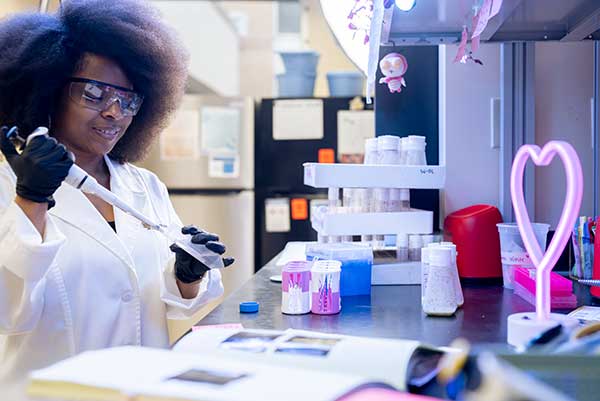
While still an undergraduate at KSU, April discovered her research passion at the intersection of biology, genetics, and molecular tool development. So, when she began in the MSIB program, she looked for a mentor who could help her advance those interests. She found that fit with Dr. Joanna Wardwell-Ozgo, whose project aligned with April’s broad interest in developmental biology. “Once I immersed myself in the project, my curiosity about hormonal signaling grew.” April said.
Steroid hormones like estrogen and testosterone are known to be key players in development, but this project takes on a new approach to an old question: how do certain proteins work alongside them to control their effect? “Historically, we lacked the tools [to reveal] how specific proteins play their roles in regulating development,” she explained. “So, we built our own toolkit.”
Steroid hormones are small biomolecular messengers that bind to their specific protein receptor. Together, steroid hormone and receptor protein turn genes on and off to drive development. This toolkit works by binding the proteins that usually bind the hormone receptor and tell it to turn a gene on or off. Once bound, these proteins can no longer be used for their normal functions in gene regulation. By introducing mutations into the toolkit and releasing one protein at a time, April and her team can identify each protein’s role in normal tissue function.

Dr. Joanna Wardwell-Ozgo echoed April’s spirit of resilience and considers working with her among the most rewarding experiences she has had as a mentor. She described with pride how April has grown from a student who needed direction into an independent researcher whose initiatives now drive the work. “April has guided this project to where it is now entirely on her own. I get to sit back, say, ‘yes,’ and watch her follow her curiosity,” she said.
April knew the MSIB program’s hands-on, impactful research opportunities with mentoring faculty made KSU the right place to continue her studies. She encourages future students to be intentional when selecting a research advisor, noting, “This is the person who will be there for you in both success and failure.” Wardwell-Ozgo agrees, adding that KSU sets itself apart by giving students unique opportunities to conduct basic biomedical research and not only receive training on advanced scientific equipment, but use it often. Together, strong mentorship and cutting-edge training give KSU students a competitive edge in both advanced study and industry careers.
By Tracy Gaudlip
Photography by Darnell Wilburn