


College of Science and Mathematics


Inspire Summer Scholars Program
The College of Science and Mathematics (CSM) invites science and mathematics majors to apply for the 2027 Inspire Summer Scholars Program!
Program Description
The Inspire Summer Scholars Programs will provide undergraduate science, and mathematics majors the opportunity to develop skills while enhancing their interest in undergraduate research, service learning, and internships.
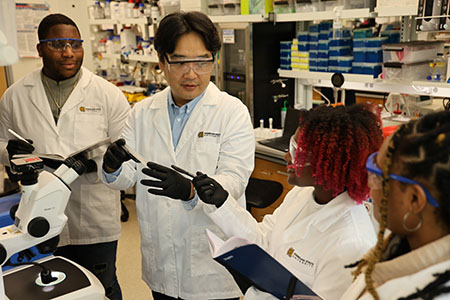
In addition to meeting the expectations of the research project, students will be expected to complete lab training during the first week of the program.
Advantages of becoming an Inspire Summer Scholar
- PAY: Each student accepted to the program will be paid as a student assistant at the rate of $12.75 per hour. Although each week may vary, students may work up to 20 hours per week.
- MENTORSHIP: Selected recipients will work on an undergraduate research project with a faculty mentor during the summer program, which will run Monday, May 17 - Friday, July 30, 2027.
- EXPOSURE: Students are encouraged to participate in the Fall KSU Symposium of Student Scholars as an attendee or presenter.
Requirements
- Current student pursuing a degree in the College of Science and Mathematics.
- Undergraduate student who will not graduate until at least the Fall 2027 semester.
- Minimum institutional GPA of 3.0.
- Submission of a completed online application.
There are no course prerequisites for this program. Preference will be given to students in their first or second year of study.
Deadlines
- Applications will be accepted starting Monday, March 1, 2027.
- Final submission deadline is 11:59 pm on Friday, March 26, 2027.
- Selected recipients will be notified via email by Friday, April 16, 2027. Upon notification of the award, students will have 10 business days to accept the position.
Current Projects
Students can view available research projects based on their interests below. Students can only apply for one project. Selected students will be required to submit a report and digital poster at the end of the Inspire Summer Scholars Program.
Stay tuned. Research projects coming soon!
Faculty Information
All full-time CSM faculty are eligible to participate. Each faculty member is expected to mentor a team of at least 3 students. Faculty mentors will receive $7,000 in summer salary for mentoring 3 or more students (salary and fringe must not exceed $10,000). Funds for materials and supplies related to the work will be provided with discipline-specific considerations. Individuals or teams of faculty may apply. Faculty will be required to be present 80% of the 11 weeks (May 17, 2027 - July 30, 2027) and the maximum amount of funding for each project will be limited to $20,000. All award funds (except for student assistant pay) must be used by June 30, 2027.
For eligibility and how to apply, please see tabs below more information:
Faculty interested in participating in this program must submit a plan (3-page limit) for an undergraduate research, service learning, or internship experience that addresses the following criteria:
- Description of the overarching theme of the project,
- Knowledge and skills that students will acquire in practice, and after critical reflection.
- Budget with justification. Please provide budget request with short narrative for related costs, estimated student pay and $7,000 in summer salary (salary and fringe must not exceed $10,000, fringe should be calculated at 23.85%). Please contact Miacko Thompson if you have any questions regarding summer salary.
- How the project meets QEP Characteristics of an Engaged Learning Undergraduate Research Experience.
- How student learning will be assessed.
The faculty application deadline is Monday, November 2, 2026.
Please submit applications and questions to csminspire@kennesaw.edu
Application Review: Projects and letters of support will be reviewed, and recommended for funding by the Research Advisory Committee. Other reviewers may be consulted on an ad hoc basis where their expertise might be helpful in proposal evaluation. Project funding is dependent on availability of funds, and funding may be less than the amount requested.